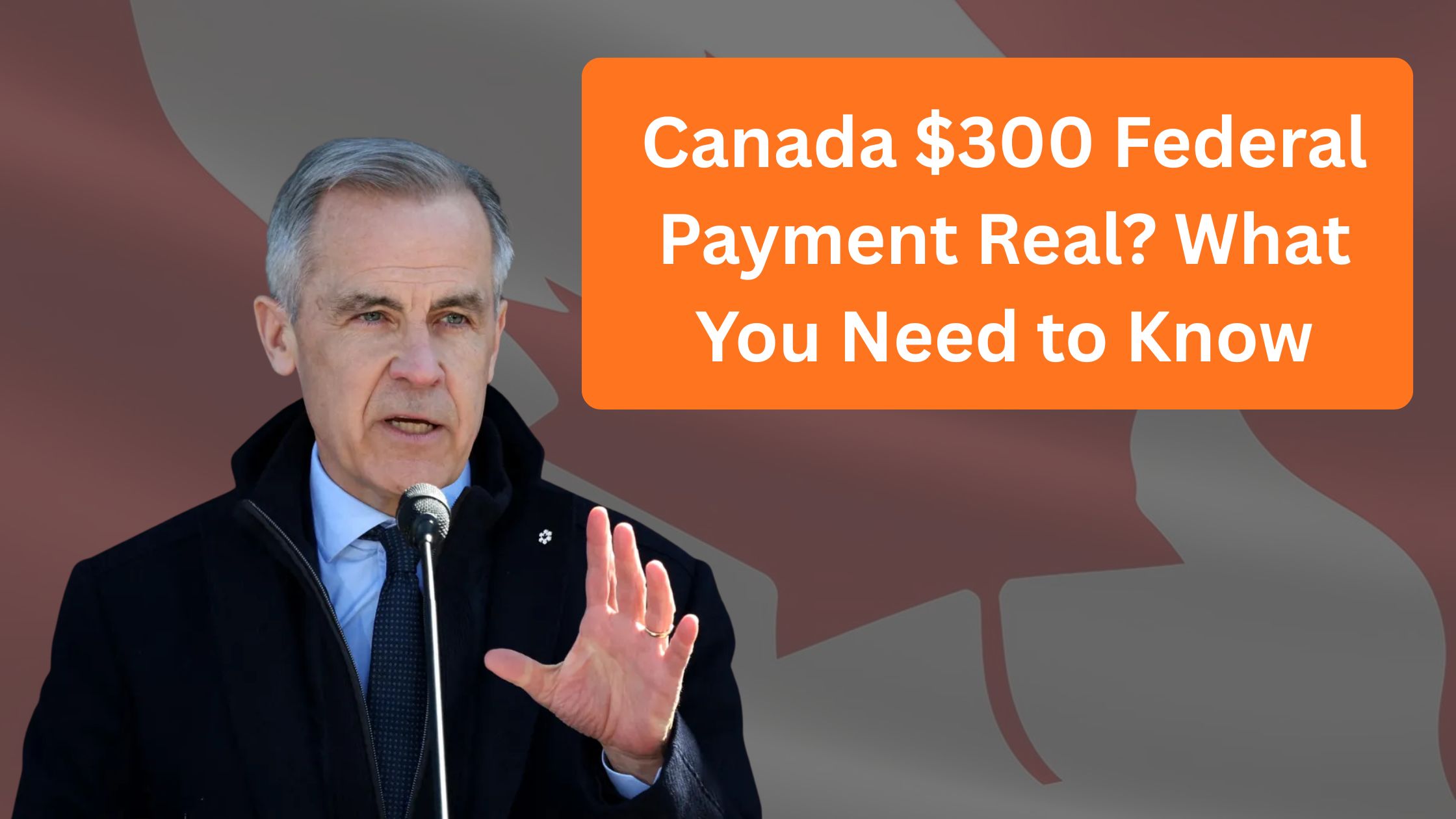
canada $300 federal payment: Many Canadians have recently heard rumours about a special $300 federal payment set to arrive in 2025, often described as a one‑time cost of living top‑up from the Canada Revenue Agency (CRA) or Government of Canada. With so much information circulating on social media and unofficial blogs, it is important to understand what this payment is claimed to be, what is actually confirmed by the federal government, and how to protect yourself from misinformation or scams.
What people mean by “$300 federal payment”
Across the internet, several articles describe a Canada $300 federal payment in 2025 as a one‑time benefit to help low‑ and modest‑income residents cope with inflation and rising living costs. These posts often say the payment will be issued automatically to eligible Canadians based on their 2024 tax return, with money going out sometime between late September and October 2025.
Some websites even present tables describing this $300 benefit as targeted at seniors, students, families and other low‑income groups, suggesting it is part of a broader federal affordability or cost‑of‑living package. These descriptions typically mention direct deposit via CRA, mailed cheques, and an automatic process with no separate application needed.
What the Government of Canada actually says
Officially, the Government of Canada has clearly warned that some online claims about new one‑time federal payments are false or misleading. Federal communications emphasize that there is no new special one‑time payment like those sometimes advertised on unofficial blogs unless it is explicitly announced on official government channels such as Canada.ca or CRA’s verified pages.
The CRA has also posted public scam alerts noting that websites and social posts may claim a new $300, $250 or similar “federal benefit” has been introduced when, in reality, no such program exists or details have not been confirmed. Canadians are urged to rely on official benefit pages and the CRA’s My Account portal to verify any new payment.
How real federal benefits are normally delivered
Most genuine federal benefits and credits in Canada are delivered through well‑known programs, not sudden surprise cheques. Examples include:
- Canada Child Benefit (CCB) for families with children.
- GST/HST credit for low‑ and modest‑income individuals and families.
- Old Age Security (OAS) and Guaranteed Income Supplement (GIS) for seniors.
- Provincial and territorial programs administered by CRA, like the Ontario Trillium Benefit or Alberta child benefits.
Each of these has clear eligibility rules, regular payment calendars and transparent information on Canada.ca, with payment dates usually listed by month for the entire year. When the federal government does introduce one‑time support—such as previous housing top‑ups or temporary cost‑of‑living relief—it also provides detailed program pages, application instructions where needed, and clear timelines.
Why so many sites mention a $300 benefit
Several third‑party blogs and education or immigration sites have begun publishing guides on a “$300 Federal Payment Canada 2025”, presenting it as confirmed relief for low‑income Canadians. These articles often repeat similar language about inflation, groceries, rent, and utility bills, and they sometimes mix real CRA benefit information with unverified claims about new cash top‑ups.
Some pages describe the $300 as being tied to Old Age Security or retirement pensions, while others say it is linked to GST/HST credits or general low‑income eligibility based on 2024 tax filings. This inconsistency across non‑official websites is a strong sign that the information is not coming from a single, authoritative federal announcement.
How to tell if a $300 payment is legit
To figure out whether a Canada $300 federal payment is real and applies to you, it helps to follow a few practical checks.
Key steps to verify any federal payment claim:
- Log into your CRA My Account and check the “Benefits and credits” and “Accounts and payments” sections for any scheduled or issued amounts.
- Compare any claim with the official Benefits payment dates calendar for programs like CCB, GST/HST credit, OAS, CPP, and others.
- Look up the benefit name directly on Canada.ca and read the official eligibility and payment rules.
- Be cautious of sites promising “secret” or “exclusive” federal cheques that are not mentioned on government pages.
If a supposed benefit does not appear in your CRA account, is not listed on Canada.ca, and has no federal news release or Budget document behind it, it is likely misinformation or speculation.
Protecting yourself from scams
In recent months, Canadian authorities have warned that fraudsters are using buzz around new federal payments to send phishing emails, fake text messages and social media DMs. Messages may claim you are “approved” for a $300 federal payment, asking you to click a link, share banking details, or pay a small “processing fee.”
To stay safe, remember:
- The CRA does not charge fees to release benefits or tax refunds.
- Genuine CRA messages will never ask for full banking logins, passwords or e‑transfer acceptance through a random link.
- When in doubt, sign in directly to your CRA account from a trusted bookmark or type canada.ca into your browser rather than using links in messages.
What to focus on instead of rumours
Rather than relying on uncertain talk of a $300 federal payment, Canadians can get more reliable help by understanding programs that are officially in place and by ensuring their 2024 tax return is filed on time. Many low‑ and modest‑income residents receive hundreds or even thousands of dollars each year through a combination of GST/HST credits, CCB, OAS/GIS, and provincial benefits administered by CRA.
Staying updated on the 2025 federal budget, ongoing affordability measures, and any confirmed one‑time relief (such as previously announced housing top‑ups or new year‑end support plans) is more productive than chasing unverified social media posts about a single $300 cheque.
Simple checklist for Canadian readers
If you are in Canada and wondering whether you will receive a $300 federal payment, run through this quick checklist.
- Have you checked your CRA My Account for any upcoming benefit or credit payments.
- Does the payment appear on the official benefits calendar or program page (for example, GST/HST credit, CCB, OAS).
- Has the Government of Canada or CRA published a clear announcement explaining the program, eligibility, and dates.
- Are you up to date with your tax filings, especially for 2024, since most benefits rely on your tax return information.
If the answer is “no” to these points, the safest assumption is that the $300 federal payment being discussed online is not an officially confirmed program yet, and you should be cautious about sharing any personal or financial information.
FAQs about the canada $300 federal payment
1. Is the $300 federal payment in Canada officially confirmed?
No single, nationwide $300 federal payment has been formally confirmed on official Government of Canada platforms; many current claims come from third‑party blogs and should be treated cautiously.
2. Will I get $300 automatically from CRA in 2025?
You will only receive money automatically from CRA if you qualify for existing benefits or any officially announced one‑time support; unverified $300 payment rumours are not a guarantee of automatic cash.
3. How can I check if a $300 benefit is real?
Sign in to CRA My Account, review your benefit and credit section, compare with the official benefit payment calendar, and search the benefit name on Canada.ca to confirm it exists.
4. Do I need to apply for the $300 federal payment?
For real federal benefits, application rules depend on the specific program, but for a so‑called $300 payment that is not officially listed, there is currently no recognized application process.
5. Could the government announce a $300 payment later?
Future federal budgets or affordability measures could introduce new one‑time payments, but until they are clearly announced on official channels, any specific dollar amount—like $300—remains uncertain.

Elizabeth Muenzen is an education writer and community researcher dedicated to covering school boards, local policy, and issues that impact students and families. With a strong focus on transparency and fact-based reporting, she breaks down complex topics into clear, accessible insights for parents, educators, and community members.